Why Choose Us?
0% AI Guarantee
Human-written only.
24/7 Support
Anytime, anywhere.
Plagiarism Free
100% Original.
Expert Tutors
Masters & PhDs.
100% Confidential
Your privacy matters.
On-Time Delivery
Never miss a deadline.
Consider the following supply and demand equations: Supply: p= 10+q Demand: p= 100 – 29 Show your work as your respond to the following questions
Consider the following supply and demand equations: Supply: p= 10+q Demand: p= 100 – 29 Show your work as your respond to the following questions. (a) What is the market equilibrium price and quantity? (5%) (b) What is the Total Surplus at equilibrium? (5%) (c) The government enacts a price ceiling at p = 50. What is the Total Surplus? (5%) You do not need to draw a diagram, but it is helpful. 1 (d) Calculate the Consumer Surplus under a price ceiling of p = 20. (5%) (e) What is the Deadweight Loss under a price ceiling of p = 10? (5%)
Expert Solution
1)
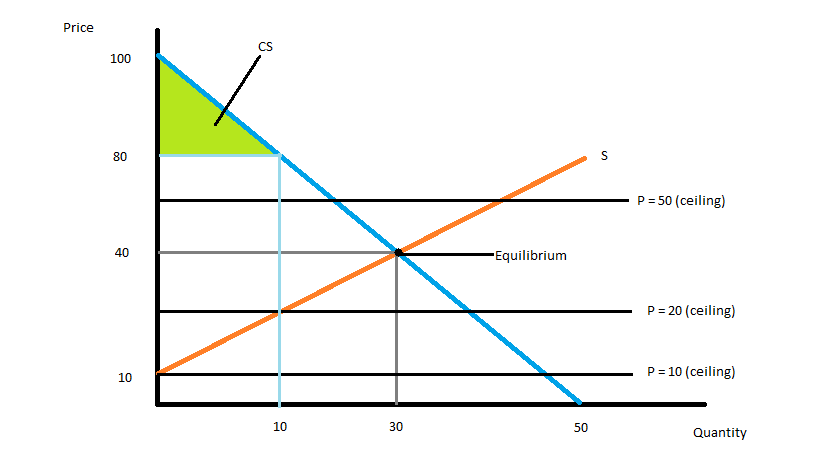
Market equilibrium is attained where Demand = Supply:
Price = 40
Quantity = 30
2)
Total surplus at equilibrium = Area bounded by Demand and supply curves with the Y axis
Total surplus at equilibrium = (100 - 10) x 30/2 = 1350
3) price ceiling = 50 (maximum price)
This would be non-binding as equilibrium price < price ceiling
Total surplus remains the same = 1350
4)
price ceiling = 20 (maximum price)
This would be binding as equilibrium price > price ceiling
Consumer surplus = green shaded region in the graph above
CS = (100 - 80) x 10/2 = 100
5)
price ceiling = 10 (maximum price)
This would be binding as equilibrium price > price ceiling
Dead weight loss = entire total surplus calculated in part 2) , this is because no supplier would be willing to supply at a price = 10.
Quantity supplied = 0
DWL = 1350
please see the attached file for the complet solution.
Archived Solution
You have full access to this solution. To save a copy with all formatting and attachments, use the button below.
For ready-to-submit work, please order a fresh solution below.